
When Dixit Became a Gender Theory Experiment
When Dixit Became a Gender Theory Experiment
Por: Stacey Chiuju Okwuchi
Universidad del Rosario
Stacey.chiuju@Esta dirección de correo electrónico está siendo protegida contra los robots de spam. Necesita tener JavaScript habilitado para poder verlo.
This blog post reflects on a classroom activity conducted during our Gender and International Security course. The purpose of the activity was to explore how theoretical concepts from the course could be interpreted through imagery and storytelling. By using the creative card game Dixit, the exercise encouraged us to think critically about how ideas such as domestic abuse, radical feminism, and intersectionality can be visualized and understood from different perspectives.
What began as a simple game quickly turned into a reflective learning experience. The activity pushed us to translate academic theories into visual metaphors and to consider how personal interpretation, identity, and lived experiences influence the way we understand gender-related concepts.
Yesterday I played Dixit for the first time, and I genuinely did not expect it to turn into one of the most reflective classroom experiences I have had so far. What looks like a simple storytelling card game somehow became a psychological and intellectual exercise in applying theories from our Gender and International Security course. It was creative, slightly chaotic, surprisingly deep, and at moments almost uncomfortably revealing.
For those unfamiliar with the game, Dixit revolves around beautifully illustrated, abstract cards. Each round, one person gives a clue about their chosen card. The clue can be a single word, a phrase, or even a song lyric. The other players then select a card from their own hand that could also match that clue. All the cards are shufled together, placed face up, and everyone has to guess which card was the original. The challenge is subtle but strategic: your clue must not be too obvious, or everyone will guess correctly. But it also cannot be so vague that no one understands it. The entire game depends on how well you can anticipate how other people think.
That element alone already makes Dixit interesting. But in our case, we had to apply theoretical concepts from class. So instead of clues like “dream” or “freedom,” we were working with terms such as domestic abuse, radical feminism, and intersectionality. It was no longer just imagination; it was interpretation layered with academic meaning.
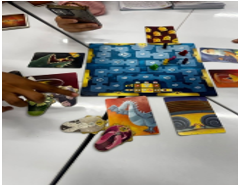
One of the first concepts introduced was domestic abuse. What struck me immediately was how differently each group visualized it. In my group, we chose a card with an anchor. For us, domestic abuse symbolized heaviness. An anchor represents weight, something that drags you down, something that keeps you stuck. We saw it as a burden carried daily, whether visible to others or not. It felt like a quiet but constant pressure.
Other groups focused on different aspects. Some selected a card of a crying animal, highlighting emotional pain and vulnerability. Our professor chose a card depicting a girl enclosed in what looked like a snow globe. That interpretation emphasized entrapment and isolation. Being trapped in a small world, separated from everyone else, unable to escape. Interestingly, multiple groups leaned toward imagery that conveyed confinement.
This was the first moment where I felt the game shift from playful to deeply reflective. Domestic abuse is a theoretical concept in our syllabus, but it is also a lived reality. Seeing how each group interpreted it made me wonder what personal associations were influencing those choices. Why did some immediately see sadness? Why did others focus on being trapped? Why did we emphasize heaviness? It revealed how the same concept can carry different emotional textures depending on experiences and interpretation
The next concept that stayed with me was radical feminism. We had discussed different strands of feminism in class, and radical feminism is often described as more extreme in its critique of patriarchal structures. My group chose a card featuring a heart engulfed in flames. For us, the flames symbolized passion. Radical did not necessarily mean destructive; it meant intense, committed, unwilling to compromise.
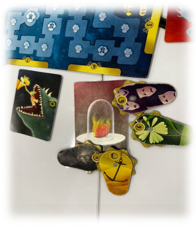
The burning heart represented conviction and emotional investment in change. Other groups, however, interpreted radical feminism differently. One selected a dragon, emphasizing fierceness and confrontation. That card conveyed something powerful but also aggressive. I found it fascinating how the word “radical” could be framed either as passionate and transformative or as combative and extreme. Both interpretations had logic behind them, yet the tone shifted significantly depending on perspective.
The most intriguing moment for me came when the concept of intersectionality was introduced. Intersectionality is one of my favorite theories because it acknowledges complexity. It recognizes that individuals are shaped by overlapping identities—gender, race, class, religion, and more—and that these intersections influence how we experience power and inequality. We are never just one thing.
Our group consisted mostly of women, with two men among us. The men were responsible for presenting intersectionality. Many of us expected a card with multiple figures, planets, or visibly layered imagery to represent complexity. Instead, they chose a card of a man sitting on a bench reading a newspaper under a dark sky filled not with stars, but with scattered letters.
At first, several of the women were confused. The symbolism did not feel immediately intuitive. But for me, it made sense in a very structured way. The letters represented multiplicity—different elements coexisting in one space. It was logical, almost analytical.
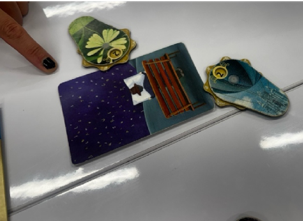
The image did not scream complexity emotionally; it suggested it systematically. This was when I became acutely aware of the psychological aspect of the game. I started paying attention to body language. I noticed where they were looking when choosing cards, which corner of the table they kept glancing at, how they reacted when certain cards were picked up. It became less about the image itself and more about predicting their reasoning process.
That, in my opinion, was the true challenge of Dixit in this academic context. It was not about choosing the card I believed best represented intersectionality. It was about stepping outside of my own interpretation and asking: how would they see this concept? How would they translate theory into imagery?
The experience forced me to temporarily suspend my own lens. That is not always easy. We are naturally inclined to assume our understanding is the most accurate or most intuitive. But Dixit requires humility. If you cannot anticipate other perspectives, you lose.
By the end of the session, I realized that the game had quietly accomplished something powerful. It made abstract theories tangible. It transformed academic language into visual metaphors. It revealed how personal interpretation shapes intellectual understanding.
More importantly, it made me curious. Curious about the people sitting around me in class. Curious about what experiences influence their associations. Curious about why some see heaviness where others see isolation, why some see passion where others see aggression, why some prefer logical symbolism while others gravitate toward layered imagery.
Dixit blurred the line between theory and personality. It showed that academic concepts do not exist in a vacuum. They are filtered through lived experience, emotion, identity, and worldview. What began as a playful exercise became a reminder that understanding theory is not just about memorizing definitions. It is about recognizing that meaning is relational.
In the end, the game was creative, challenging, and unexpectedly introspective. It required knowledge, empathy, and strategic thinking all at once. And while it may have looked like a simple card game on the surface, it became one of the most engaging ways to explore gender theory I have experienced so far and I thank my professor herefore.

